Social Media Erupts Over A Scholar’s Claim That Paul Did Not Write Ephesians Tiffny Hddish’s Ignornt Zimbbwe Grocery
For example, scholars often cite the pastoral epistles (1 and 2 timothy, and titus) as being pseudonymous because their language differs so markedly from other epistles that are believed to be authentically written by paul ('pauline') There are reasons to believe that this epistle. On the other hand, scholars will equally cite similarities between pauline letters as proof of pseudonymity.
What Books Of The Bible Did Paul Write While In Rome / Bible Fun For
Critical scholars argue that paul didn't actually write ephesians Polycarp (125 a.d.) attests to its canonicity in his own epistle to the philippians (chapter 12) Instead, critics of pauline authorship hold that one of paul's disciples forged the letter after his death
- Intergenerational Living Innovation Defines St Pauls House A Lutheran Life Community
- Parents Divided Over Screen Time Policy At St Paul Lutheran Daycare
- Why Saint Paul Early Childhood Ministries 2026 Play Lab Is Viral
This, of course, would mean that the author was a hypocrite when he tells his readers to speak truth (eph
4:15, 25) and to avoid deceitful scheming (eph The forger would also be asking his. Here's an important question i received recently from a blog member Someone told me that i should never listen to you because you say paul did not write six letters of the new testament, even though the letters start with the claim he did
Paul, an apostle of christ to the church at …. this person's main issue was What is the evidence paul did not write ephesians The new testament contains 13 letters attributed to the apostle paul, but which of these letters did he really write Certain church fathers also thought that paul wrote hebrews, but this is unlikely.

Some scholars say that paul did not write ephesians, whereas they are confident that he did write romans
Who are they talking about when they say that Some quick possibilities could be the author of romans the paul who luke speaks of the early christian missionary to the gentiles the paul who peter speaks of now, obviously, if one is defining paul as the author of romans, then the. The authenticity of ephesians as a genuinely pauline epistle has been doubted since the time of the dutch humanist erasmus in the 16th century The problem of ephesians cannot be solved apart from that of colossians.
Author some scholars say paul was the author, others say paul was not the author i believe paul did write the letter, but it is important to understand both sides of the debate I will present three arguments that some scholars use against the authorship of paul and then three arguments other scholars use for the authorship of paul Reasons to think that paul did not write ephesians. They have been historically associated with the apostle paul
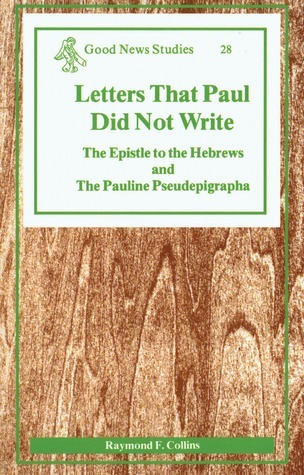
However, some scholars have questioned whether paul himself authored them
Examining why certain researchers propose that paul did not write these letters. According to new testament scholar daniel wallace, the theme may be stated pragmatically as christians, get along with each other Maintain the unity practically which christ has effected positionally by his death. [10] another major theme in ephesians is the keeping of christ's body (that is, the church) pure and holy For some time, scholars have been divided over the status of certain of paul's letters, namely ephesians, colossians, 2 thessalonians, and the pastorals (1 and 2 timothy and titus), with the consensus being that these are not genuinely pauline.
Some quick possibilities could b. Most scholars are convinced that paul did not write ephesians Rather than addressing one community, it may have been sent to a number of churches. If paul did not write ephesians/colossians, why would someone use the name of paul to promote a teaching that some see as endorsing misogyny

The standard answer has been that ephesians/colossians were probably written decades after paul's death in the 60's, between the years of 70 and 100 c.e.
Explore the authorship, themes, and messages of the book of ephesians This article delves into its theological teachings, ethical exhortations, and the debate over whether paul wrote it. It is academic consensus that paul did not write the pastrol epistles It is such a majority position that it is assumed in critical scholarship of the letters, and not argued because it is taken for granted.
Ephesians is one of the books in the pauline collection which is frequently assumed to be pseudonymous Rather than written by the historical paul, the letter was created in the late first century. The three earliest witnesses to ephesians (sinaiticus, vaticanus, and an early papyrus [p 46]) do not contain the phrase in ephesus. however, there are good reasons to believe it was the original reading. Examining why certain researchers propose that paul did not write these letters provides insight into a range of issues, from style and vocabulary to historical context

Overview of the scholarly debate
Reactions poured in on both sides of the aisle following the conclusion of the first presidential debate between former president donald trump and vp kamala harris. Social media erupts over ai vs indian govt clash the controversy erupted after grok responded to a user's query in an unfiltered manner, leading to accusations of bias against the ruling bjp. This book was apparently written by a later christian in one of paul's churches who wanted to deal with a big issue of his own day The relation of jews and gentiles in the church
He did so by claiming to be paul, knowing full well that he wasn't paul He accomplished his goal, that is, by producing a forgery. A:surprisingly, paul did not write the epistle to the ephesians Burkina faso's president ibrahim traoré is at the center of global attention after reports of a possible coup attempt surfaced

From africa to the diaspora,.
Most scholars hold that paul wrote ephesians as a circular letter—not a specific one That is, a later scribe most likely added the words To the saints who are at ephesus … The epistle to the ephesians introduction author
Early sources in church history that attribute this letter to paul include Irenaeus (200 a.d.), clement of alexandria (200 a.d.), and origen (250 a.d.)